localzuk
-
Posts
27,412 -
Joined
Content Type
Forums
News
20th
EduGeek EDIT Conference
Blogs
Everything posted by localzuk
-

Biometric fingerprints - polish school fined!
localzuk replied to Jaymate's topic in Data Protection & Information Handling
The risk isn't about it being leaked, but one of privacy of personal data. That data may not be able to be reversed, but it can still be used to identify someone - police could use that data to identify someone for example. The way the law is written, the default position is to not collect or process personal data. So, you have to go through the various steps to justify using it. Saying it is encrypted is not enough. -
We use a class A network in our Trust, but it is split up into multiple subnets for each site, then further for individual subnets for different functions. If you're a single school though, I can't see the purpose of doing so. Even the biggest school won't need more than a few thousand IPs, something like a /20 or /19 overall. I'm reality, it doesn't really matter.
-
[windows software] Student RDS Server 2012 CALS? Anyone got Crayons?
localzuk replied to JRA's topic in Licensing Questions
I believe you are wrong. I've operated this way with OVS-ES since having an RDS setup that children use - I had my reseller double check when we started too. But it only covers it internally - ie. If you're using thin clients. It doesn't cover external use, you need an external connector for each RDSH on top. -
Lol, I can just imagine rolling out 4 port switches across a site! We'd need approximately 250 of them. Or, you can get a 24 port 2.5G switch for £1100. So, 10G would be at least £55k. 2.5G would be about £35k. Oh, not to mention having to plug in 250 switches vs 32. More realistically, Ubiquiti do 16 port 10GbE switches for about £430 each. Still need the SFP+ modules, but you could do it much more reasonably.
-
[windows software] Student RDS Server 2012 CALS? Anyone got Crayons?
localzuk replied to JRA's topic in Licensing Questions
Staff don't need one, no. The external connector license is for users who are not "employees, contractors or agents". And yeah, that's right. However, with RDS - if you have OVS-ES licensing, you can get RDS CALs for your FTE count, and this will cover all your students as well - you just put that number in the licensing server with your agreement number. -
[windows software] Student RDS Server 2012 CALS? Anyone got Crayons?
localzuk replied to JRA's topic in Licensing Questions
You would need an "External Connector License" for each RDS server they use too I believe (so, if it ends up being a farm of 2 RDS servers, you need 2 external connector licenses I think) - as children aren't covered by the normal licenses when connecting in from outside IIRC, as they're not technically employees. -
GOOGLE PLANS TO MOVE USER INFO OUTSIDE EU
localzuk replied to nettihen's topic in Data Protection & Information Handling
Under US law, that's not correct. The company that has had data requested from it could object on that basis, and take it to a US court. But, GDPR is not a US law, so as much as it applies to US companies and their subsidiaries, the US government is not bound by it. SafeHarbor provides a little bit of defense that can be used. An example situation - the famous case where the FBI wanted data from Microsoft that was on their Ireland servers. They took it to the courts, to prevent it because it would be a problem with Irish law. When CLOUD Act came in, the FBI dropped the entire thing, filed their warrant in accordance with CLOUD and Microsoft had to comply. -
[GCDS] - Disabled AD accounts to Suspend GSuite accounts
localzuk replied to timbo343's topic in Cloud Services
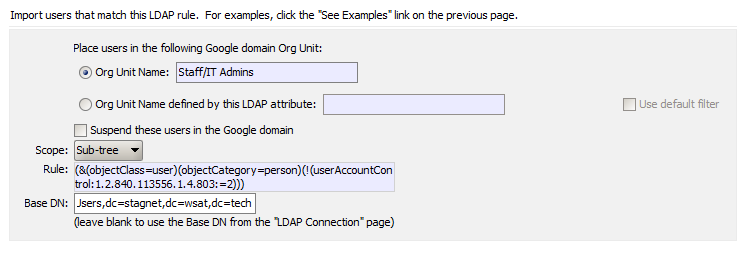
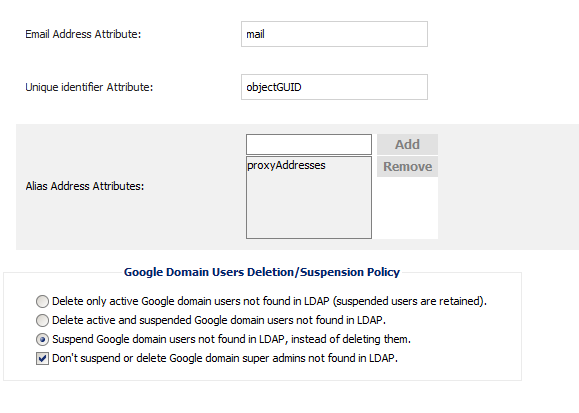
That only detects enabled accounts. GCDS is set to disable accounts no longer found automatically. So, this is an example rule: And the User Accounts screen settings:
-
GOOGLE PLANS TO MOVE USER INFO OUTSIDE EU
localzuk replied to nettihen's topic in Data Protection & Information Handling
Not according to US laws. Basically, the CLOUD act gives the US govt rights to see that information if the company storing the data is a US owned entity. Eg. Microsoft UK Ltd or whoever. The act provides some mechanisms to challenge such requests, but overall the companies are subject to US requests wherever they put their servers. So, this change makes no difference to US government access to our data - they were legally able to get it before this change, and are still able to get it now. -
[GCDS] - Disabled AD accounts to Suspend GSuite accounts
localzuk replied to timbo343's topic in Cloud Services
We have all our search rules as such: (&(objectClass=user)(objectCategory=person)(!(userAccountControl:1.2.840.113556.1.4.803:=2))) and that seems to work. -
We use ResolveIT in Bridgwater, Somerset. Free collections, and they offer differing levels of data destruction - from free wipes, to onsite disk shredding etc... https://www.resolverecycling.co.uk/
-
This is wrong IMO. Computing is a subject designed to teach how to code. Not how to code in a specific language. The subject should be teaching, and emphasising, the basics - data structures, loops, operators, strong vs weak typing, etc... Those are all transferable skills, and will apply in all languages. If the best way of doing that is using something like BASIC, go for it. If its Python or Go, have at it. The reality is, the concepts are what matter, not the specific syntax. A good teacher will be showing multiple languages and how they implement those concepts. Its why computing generally goes up in complexity, from something like Logo to Scratch to Python etc... It shows how those skills transfer - after all, a for loop is a for loop regardless of language. Just so long as you aren't teaching them Javascript, we're all good. Because that would just be sadism.
-
Yeah, we use Papercut with our Ricoh MFDs to do this. I believe Ricoh have tools to do this without Papercut too. We use the Ricoh IM C300. EDIT: Just noticed that this is for home, so I doubt you're wanting to spend £3k+ on a printer lol. I believe HP have this capability on their web connected HP printers too. Their Envy range at least has it.
-
Don't make the mistake that many do of looking at average usage and using that as the guide for what size switches are a good idea. Peaks are more important in schools - as we regularly have huge numbers of people doing a task suddenly and at the same time. Realistically, these days, your edge switches are having to do a variety of tasks - connecting client PCs, running APs etc... So, you have to look at the needs of your heaviest using connected device, which will be your APs. Which will easily saturate a 1Gbps link if you have a lot of wireless connected devices. There's quite a few APs on the market that use 2.5Gbps ports now. In reality, these days, the choice are switches with 1Gbps ports and 1Gbps SFP ports, of 1Gbps ports and 10Gbps SFP+ ports. 100Mbps ports are outdated and I don't think HPE Aruba even sell any managed switches with that spec any more.
-
We used to go with HPE Aruba, but these days? All switch purchases are Ubiquiti Unifi. 48 port 1Gbps, 4 port SFP+ (10Gbps), 500W POE for £580? Compared to £1340 for the HPE Aruba 2540 JL357A.
-
Officially launched June 2018 - with emails sent out to customers (we received at least 1, plus several before the launch email about its development). It was in "early release" for some customers before that date too.
-
Whilst the theory of what you suggest may seem sound, remember that many teachers simply won't know what Flash is and whether the tools they use utilise it. We are not here to simply tell staff that a tool they don't really know anything about is stopping working. We are here to tell them it is stopping working, then assist them in identifying things that use it and advise that those particular things will need replacing.
-
A requirement of what?
-
VMware to Hyper-V, back to VMware
localzuk replied to nezzbit's topic in Thin Client and Virtual Machines
We bought VMWare Essentials Plus (3 hosts, 2 CPU per host) a few years ago. Was about £2900. Then we pay about £850 a year support/maintenance. -
First contact with computers was when I was 3 or 4 IIRC, my dad brought a Acorn Archimedes home from school and we played Repton on it. When I was 6 or 7, my dad bought a Mac Color Classic, which we later paired with a 9600 baud modem ("no longer used" by his school), and got our first taste of the web. Later upgraded the modem to a 28.8kbps one. Eventually I got my first computer of my own, rather than the shared family one - a Mac LC III, which I mostly used to play Munchies. Eventually we moved, and the old Macs were replaced by a single family Mac Performa 5300, with a 56k modem, and its own TV card! Wrote a booklet on how to use all the different shortcuts on the Macs in my primary school and got it sent to the other schools. So, that's where my interest in IT came from, actually getting in to IT as a career, I ended up developing a Windows network for my Dad's electronics department - Around 20 scavenged PCs, ranging from 486 to Pentium 1's, all connected via 10Base2 and a P2 machine as a server. Initially running Windows 95 on the clients, and a Linux distro on the server. Eventually upgraded it to Win NT4 on both client and server, with the server now 2 servers. Went to uni to study CS, dabbled with their Unix servers, worked for the uni in their tech division doing virus removal on student PCs and topping up print budgets and doing basic help tasks, ran a web hosting business for a few years, then dropped out final year due to various issues in my life. Needed a job, so scatter-gunned job applications. Got a job offer in Minehead and well, that's it really!
-
The site hosts adult material, so it is blocked here. Eg. Search "adult" and you'll find a bunch of copyright infringing rips of adult scenes from movies.
-
[ms office - o365] office 365 or office 2016
localzuk replied to lionsl2005's topic in Office Software
The thing is, we seem to just be repeatedly being told the same thing, and we don't seem to be getting anywhere passing back to them "WHY?!". Why have they made this arbitrary decision to exclude OVS-ES from a license type that doesn't cost them anything? And it doesn't seem like anyone at Microsoft is going to listen or answer that question. -
Exams are rarely about simply remembering formulae - they usually test your ability to apply that formula, and recognising when that formula applies.
-
We do periodic online testing with every child in our Trust - 3 times a year. We manage here, but are improving things. We use GL Testing, which is a web based test. It used to use Flash, but doesn't any more. The requirements are basically computer with web browser and sound output. Its one of the reasons we're rolling out Chromebooks to everyone.
-
[Gsuite] SMTP connection fails after X emails
localzuk replied to timbo343's topic in Cloud Services
From what I can tell, the relay service uses its own limits - but you weren't using the relay service, you were using SMTP with app passwords. So that's probably the issue. That said, I'd worry about any individual service sending 75 notification emails in such a short period as to trigger the normal SMTP limits too.