Irazmus
-
Posts
362 -
Joined
Content Type
Forums
News
20th
EduGeek EDIT Conference
Blogs
Everything posted by Irazmus
-

[sims] SOLUS 3 down?! 'Unable to define target type'
Irazmus replied to MrMat's topic in MIS Systems
We're getting the same error here. ( Unable to define target type, module has not been loaded ) At least we can take some comfort from the fact that we're not the only ones. -
Do you allow youtube in your school?
Irazmus replied to Ben_Stanton's topic in Internet Related/Filtering/Firewall
Unblocked for staff, YouTube Edu enforced for pupils by county. Also, poll updated. -
There's also Koha Again it's free and open source and can pull book info from online catalogues (like the British Library). Although getting the connections to online catalogues can be tricky as the protocol used can't run through an HTTP proxy so you will need some outbound ports opening, which not all RBCs/county councils are happy to do. Ours took a little persuading. We were going to replace Junior Librarian with this until we realised that many of the ISBNs in our database were incorrect so we couldn't perform a direct migration, and with the school closing next year, it wasn't deemed economical to do it manually.
-
Prize-a-day-May! Win merch, tablets and a PC with VeryPC
Irazmus replied to VeryPC's topic in Our Advertisers
Hurrah, I actually won something. Thanks @VeryPC. Also: newbie?
-
How to block onyl NSFW youtube vids?
Irazmus replied to graeme2409's topic in Internet Related/Filtering/Firewall
Have you had a look at YouTube for schools? It's not quite what you've asked for as I believe it works on a whitelist system rather than blacklisting or filtering, but it would certainly allow you to prevent access to NSFW content without blocking the whole site. -
Self Service Password reset question
Irazmus replied to RoyaMarie's topic in EduGeek Self Service Password Reset
There was a video in the works, but it fell by the wayside long ago. I don't even have the source files anymore. @plexer What a coincidence, I've been planning to port SSPR to CakePHP or Ruby on Rails so I can scrap my old IIS server, but I've not managed to find the time yet. -
A couple of our APC UPSs have recently died, and while looking for replacements I've come across a rather well specced Delta Gaia UPS which is half the price of the equivalent capacity APC Smart-UPS. On paper the Delta looks to be higher spec than the APC (Double Conversion as opposed to Line Interactive (Unfortunately that's as far as my UPS knowledge goes)), but since I've not come across Delta Electronics before, and the price difference is so large I'm a little wary. Does anyone have any experience of Delta Gaia UPSs, or Delta Electronics in general? Or are there any reasons the Delta would be inferior to the APC? Delta Gaia Series 3kVA On Line Rack/Tower Style UP - Misco.co.uk APC Smart-UPS XL 3000VA RM 3U 230V - Misco.co.uk
-
You will need (at least) two Twitter accounts, one to post alerts to, and one (per person to be alerted) to follow the alert account. I keep the alert account's timeline private as I don't want to announce system issues to the world. You will also need to install Tweepy [ tweepy - Twitter API library for Python - Google Project Hosting ] and it's dependencies, Python 2.5+, Simplejson, Python-OAuth, python-memcached. Excuse me if I miss anything out, it's been years since I set this up. If memory serves, you will need to register a new application with Twitter. Register it online [ OAuth FAQ | dev.twitter.com ] then enter consumer secret and key in the variables below and run the first script. /usr/local/nagios/twitnag-authorize.py #!/usr/bin/env python import tweepy CONSUMER_KEY = '' CONSUMER_SECRET = '' auth = tweepy.OAuthHandler(CONSUMER_KEY, CONSUMER_SECRET) auth_url = auth.get_authorization_url() print 'Please authorize: ' + auth_url verifier = raw_input('PIN: ').strip() auth.get_access_token(verifier) print "ACCESS_KEY = '%s'" % auth.access_token.key print "ACCESS_SECRET = '%s'" % auth.access_token.secret Take the access secret and key produced by this script and add them, along with the consumer secret and key, into the second script, and update the proxy details as needed. /usr/local/nagios/twitnag.py #!/usr/bin/env python import sys import tweepy CONSUMER_KEY = '' CONSUMER_SECRET = '' ACCESS_KEY = '' ACCESS_SECRET = '' auth = tweepy.OAuthHandler(CONSUMER_KEY, CONSUMER_SECRET) auth.set_access_token(ACCESS_KEY, ACCESS_SECRET) api = tweepy.API(auth, proxy_host="proxy.county.org.uk", proxy_port="8080") api.update_status(sys.argv[1]) Then create two new definitions in your Nagios config. /usr/local/nagios/etc/objects/commands.cfg define command{ command_name notify-host-by-twitter command_line /usr/bin/python /usr/local/nagios/twitnag.py "$NOTIFICATIONTYPE$ - $HOSTNAME$-$SERVICEDESC$ - $SERVICESTATE$ - $SERVICEOUTPUT$" } define command{ command_name notify-service-by-twitter command_line /usr/bin/python /usr/local/nagios/twitnag.py "$NOTIFICATIONTYPE$ - $HOSTNAME$-$SERVICEDESC$ - $SERVICESTATE$ - $SERVICEOUTPUT$" } Add the new commands to your contact definition(s). /usr/local/nagios/etc/objects/contacts.cfg service_notification_commands notify-service-by-email notify-service-by-twitter ; send service notifications via email and twitter host_notification_commands notify-host-by-email notify-host-by-twitter ; send host notifications via email and twitter Now restart Nagios and any system alerts are sent to Twitter, and you can use their SMS gateway to receive alerts without paying* * Assuming you're on a supported mobile network.
-
Another vote for Nagios. For 5 printers any old PC should do you, and you can get Nagios to alert you however you want. Ours alerts via e-Mail, SMS (via Twitter) and a display screen in the office.
-
Unfortunately I can't remember the exact process (and it didn't get logged since it was the helpdesk database we were trying to recover), but I'm sure it was ext3grep which saved my skin. There was more info in this thread but it seems to have gone AWOL, however the most important item was a link to the ext3grep documentation, which I believe can be found here: HOWTO undelete removed files and directories on an ext3 file system That's assuming you're using an Ext3 file system as I was, if you're using a different file system you'll probably need to look for other tools. For recovering files from NTFS volumes I've found ntfsundelete to be useful. I've not (yet) had need to recover from any other file systems so can't advise if you're using a file system other than those two. And in case it wasn't obvious, both those recovery operations were performed in Linux (Debian 5.0.8 to be exact). As mentioned above, we didn't manage to recover every MYD file, we lost the printers and tracking tables, but we did manage to recover most of them. I wish you luck in your recovery efforts. Let us know how you get on.
-
Room Booking - MRBS (Customized) Asset Management - OCS & GLPI Help Desk - GLPI Active Directory Adding Users (Bulk) - Custom VBScript Print Management - Pykota Software Deployment - WDS/BDD & GPO Image deployment - WDS/BDD
-
I haven't run the 2.3 update yet, but the update to 2.2 was an absolute a**e. Samsung's Kies software, which seems to be the only supported way of updating, is more than a little buggy, it took 4 separate computers before I found one from which it was willing to run the update (which coincidently was an NC20). Don't let that put you off the phone, it's a nice bit of kit, it's just a shame Samsung's software lets it down.
-
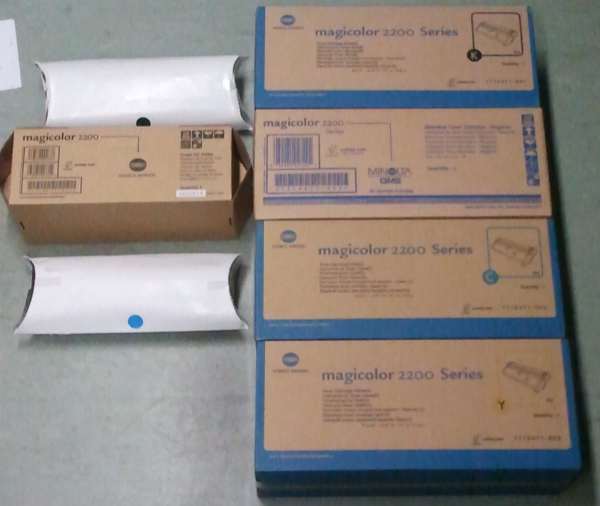
While clearing out the office for a refit we have come across a full set of toners (K,M,C,Y) and a Fuser Oil Roller for a Konica Minolta Magicolor 2200. We scrapped the printer some years ago so have no use for the toner or roller and will consider pretty much anything (within reason) in trade. I think we have a second K and C cartridge, but the packages and toner lack any branding so I can't be certain, although they look the same as the images on the boxed set. Pickup available in Mid Suffolk, or we can post if required.
-
That issue is usually due to lag between the server and client and is an issue known to Mojang. One work around if the missing chunks are few in number is to modify a block adjacent to the missing chunk (placing a torch is enough), which forces the client to update the chunk, rendering it visible and usable again. Although if half the map is missing, a relog tends to work better. This does assume it's not your Internet connection that's lagged, as obviously that has a different fix
-
Stowmarket Middle School
-
Virtualization Plan Sanity Check
Irazmus replied to Irazmus's topic in Thin Client and Virtual Machines
Doh! I stand corrected. * Fetches dunces hat and goes to write lines in the corner I will get my facts straight before nit-picking someone's comments. I will get my facts straight before nit-picking someone's comments. ... No idea is a bad idea. With the exception of nit-picking without doing proper research first [facepalm] I was thinking of the print and web servers which will want generous amounts in exceptional circumstances (~100MB document or entire school accessing Moodle), but only moderate amounts during normal usage. If I'm right, Ganeti doesn't do auto failover, but the LHAP does, so I should be able to combine the two to get the benefits of both. Either that or I'll end up with an unmanageable mess. But since full HA is desirable, not essential, it won't be the end of the world if I can't get it working. Again I stand corrected. Since I can't wear more than one dunces hat at once, I'll just have to wear it for twice as long. But I know my way around Debian better so I'll still stick with that, unless Gentoo tempts me away (fickle?) -
Virtualization Plan Sanity Check
Irazmus replied to Irazmus's topic in Thin Client and Virtual Machines
I'll definitely look into that, especially for those (nix) servers that could do with more RAM anyway. It's partly an expense thing, but it's also the fact that it's GPL. We looked into ESXi but decided against it for a number of reasons. I couldn't see any way to get High Availability and auto failover, which I think I can probably manage with KVM/Ganeti/LHAP. It's not vital but I'd like to have the option for later. I also don't think it's possible to have local VM storage using DRDB (or similar) to clone between VM hosts. Without the DRDB cloning I can't avoid using network storage for VM images while maintaining quick recovery. I was initially planning to use Xen with Ganeti, but KVM has replaced it as it's kernel based. I may still use some Xen hosts if some of my older kit doesn't support HVM, but that's a decision I can finalize later. @jamesfed I don't mind a little doom saying, the more information/opinions I get, the better. I take your warning on board, but SIMS is too important to run on unsupported hardware so we have to act now, either with a new SIMS server, or by starting the virtualization. The upside is that most of the load will be put on the new server, the 2800s will actually get less of a hammering since they'll be sharing the load (unless one decides to fail) and will only be serving user files. Plus the drives they'll be using are only ~3 years old since they aren't original to either server, they were added as an upgrade. But if this all goes to pot because we're cutting corners, you have full permission to say 'I warned you' in a vaguely Scottish accent and then throw a rabbit at me Not to nit-pick, but Hyper-V isn't free, it's included in the server licence cost, and we have no 2K8 licences, nor 2K8 CALs either (Which I assume I'd need to allow clients to connect to the VMs). To sort the above plan using Hyper-V, we'd need a 2K8 licence for the new host and each of the backup hosts. When adding the CALs on (250 computers @ £3.70) , we're looking at ~£1200 - £1500, which I'd rather put towards the hardware. That and I'm happier managing *nix machines. @NS_tech I'm confident I can get the upgrade, but prefer to err on the side of caution until it's confirmed. The HP DL3xx range come up often in the virtualization threads here so it seemed the obvious choice, especially when you compare the prices to Dell. I'll definitely report back when we get it running, but it'll probably be the summer before we really get going with it. -
Virtualization Plan Sanity Check
Irazmus replied to Irazmus's topic in Thin Client and Virtual Machines
Firstly, thank you to everyone for all the advice, I'll go through again later and thank individual posts. @jamesb Is that a bit fine just on the RAM or the CPU as well? I can probably persuade our Business Manager to cover an upgrade to 24GB, but I'm working on the assumption of 16GB for the time being. Since we're currently running those services (except Syslog) as separate hosts we should be able to manage. But we can lose IIS, WDS and the Intranet without much issue. And if absolutely necessary I can always press-gang my desktop to assist. We currently have 2 DCs, 1 of which will be staying physical as I'm too paranoid to virtualize them both. @sted The host OS will either be Debian or Gentoo running KVM as hypervisor. I'm more comfortable with Debain, but Gentoo has support for newer versions of Ganeti. The print server is a Debian, CUPS, Pykota box, so merging with WDS isn't possible. I guess I should have mentioned which OS each VM is running, I may go back and update that. @FN-GM Merging IIS into the SM box is an idea I'd not considered, although I'd like to try to segregate services if at all possible, since that's one of the things that attracts me to virtualization. I'd planned syslog to run on Debian, but I'll look into Windows options as a possible alternative if RAM becomes an issue. @glennda That sounds like a nice setup. I looked into SANs but they're simply out of our price range, although it's definately something to aspire to and your CPU numbers are reassuring. @sted It's probably rather fortunate we're still running 2K3 then. I'd like to at least upgrade our DCs to 2K8 but the cost of new CALs would prevent us buying the VM server. Our budget really is that tight this year. @plexer No, the 2800s will be mirrored file servers running OpenFiler. Not ideal since Dell will be classifying them End of Life later in the year, but we should be able to keep one going by robbing parts from the other if needed. @Mr.Ben If and when KVM supports it I may well do that. But even if KVM did support it, for planning I'd still assume them to each have dedicated RAM, at least that way I shouldn't under spec. @dhicks I think I already checked that, but I'll double check to be safe. Yes mirrored as in DRDB style, just in case the server itself fails. We have a separate backup for disaster recovery (External HDDs stored in a firesafe in a separate building, with 3 TeraStations for server/VM backups). My home server and half the servers here run Debian, the only reason I'm considering Gentoo is that Ganeti seems to be better supported there. -
We are currently planning our first real foray into server virtualization and I'd appreciate a sanity check for our plans from someone who has more virtualization experience than me. This is going to be a long one, so please bear with me. History: Over the last few years our server numbers have grown to the extent that we are over provisioned and most servers are under utilized (but have insufficient RAM for running multiple VMs). In addition, our SIMS and file servers (both Dell PowerEdge 2800s) are about to come out of warranty with no option to extend. Due to local and national politics we are very short of money this year and cannot afford virtualization servers and to replace the file server. What we can afford is to buy a server to start virtualizing and to move half the drives from our file server into our SIMS server and run the two machines as mirrored openfilers until we can afford a replacement next year. For the VM host we're looking at buying an HP Proliant DL385 1 x AMD Opteron 6176SE (2.3GHz, 12 core) (Second socket for later expansion) 16 GB (8 x 2 GB RDIMM) Performance DDR3 RDIMM (256GB max) 4 x 600GB 6GB/s 10Krpm SAS DP (Expandable to 8) OR 4 x 500GB 3GB/s 7.2Krpm SATA (Expandable to 8) with a second to be bought in year 2 or 3 for redundancy. Until we buy the second, our existing servers will be used as backup VM hosts, with each being added to the cluster when it's current role is virtualized. VMs will be stored on the VM host and mirrored to their backup machine with DRBD [ DRBD:What is DRBD ] to allow for failover without a SAN. Virtualization will be provided by KVM on Debian (or possibly Gentoo), with Ganeti [ ganeti - Cluster-based virtualization management software - Google Project Hosting ] for VM management. The VM's I intend to have running from this host are: HDD Use OS RAM ------------------------------------------------- 20GB Host Debian 1GB 50GB SIMS W2K3 2GB 20GB DC W2K3 1GB 20GB IIS W2K3 1GB 40GB SuccessMaker W2K3 1GB 100GB WDS W2K3 1GB 15GB Print Debian 1GB 100GB Webserver Debian 2GB 20GB Proxy *nix 2GB 15GB Intranet Debian 512MB 15GB Syslog Debian 512MB 240GB Zimbra (e-Mail) Debian 2GB 655GB Total 15GB with the possibility for separate MSSQL and MySQL hosts, and a puppet server further down the line. ---------------------------------------------------------------------------------------- Can anyone see any issues with this plan or am I actually managing to have a lucid moment?
-
I had some luck with file recovery from an NTFS drive yesterday using ntfsundelete under Debian. The file system I was recovering from was intact which is probably why it worked so well. I suspect it would have been different if the inodes had been deleted, but it can't harm to try.
-
We've had a spate of these lately. Our issue is caused by Windows seemingly losing the wireless certificate provided by GPO. A quick gpupdate when hard-wired solves the issue, but we haven't yet found the underlying problem.
-
No problems on the Samsung Galaxy S (Android 2.1) and Tab (Android 2.2). I'd like to see integration with GLPI so we can more quickly input equipment (peripherals mainly).
-
Thanks for the info. We've managed to recover most of the database using the above link, the one table we couldn't recover held the helpdesk tickets, which we've (mostly) reconstructed using the helpdesk's e-Mail notifications. I think it's safe to say we were lucky this time.
-
Does anyone have any ideas?
-
Last week one of our servers decided to delete the entirety of /var, including all it's logs and our helpdesk's MySQL database. To make matters worse, although the backups live on a separate machine, they also appear to be missing /var and are thus useless. I have tried a few different recovery utilities in an attempt to recover the database, the most successful being photorec [http://www.cgsecurity.org/wiki/PhotoRec], which has recovered 200+ frm (table definition) and MYI (MYISAM compressed data) files, but none of the MYD files which actually hold the data (it seems PhotoRec doesn't support recovering MYDs [http://www.cgsecurity.org/wiki/File_Formats_Recovered_By_PhotoRec]). Can anyone please point me to a tool/method for recovering MYD's from a corrupt ext3 filesystem. Assuming that's possible, a method of linking the MYD to it's appropriate frm and MYI (since the recovered files have random file names) would also be appreciated. *Next task, review the backup verification procedure.