


The Infrastructure Gap Holding Schools Back
With tight education budgets and small IT teams, school network managers are often dealing with ageing infrastructure that’s no longer fit for purpose. This makes it difficult to introduce new initiatives or innovate effectively, particularly when the underlying network cannot support modern teaching and learning requirements. Projects such as 1:1 device rollouts or multi-site deployments can feel especially daunting without a solid foundation in place.
Many schools want to move forward but are not interested in a one-size-fits-all solution. They are looking for approaches that genuinely improve teaching and learning while also making day-to-day IT management easier. Even with a broad range of technical knowledge, starting a new infrastructure project can feel overwhelming given the number of factors that need to be considered.
This is where experienced wireless professionals add real value. A successful deployment begins with a predictive design, using specialist software to model RF propagation based on building materials, floor plans, and expected client density. However, predictive modelling alone is not always enough. On-site passive and active surveys are essential to validate these assumptions and capture real-world RF behaviour, including signal strength (RSSI), signal-to-noise ratio (SNR), and interference levels. The resulting heatmaps provide clear, visual insight into coverage gaps, channel overlap, and capacity constraints.

In a typical UK school environment, RF behaviour can be highly unpredictable. Many sites are made up of older brick buildings alongside newer modular classrooms. Thick masonry walls, metal structures, and even underfloor heating systems can absorb or reflect wireless signals in unexpected ways. It is not uncommon to see deployments where access points appear to provide coverage on paper but are effectively unusable due to poor SNR or excessive contention, particularly in the 2.4 GHz band. Without proper surveying, these issues often only become apparent once users begin to experience problems.
Spectrum analysis is another critical area that is frequently overlooked. While standard WiFi surveys focus on wireless networks, spectrum analysis identifies non-WiFi interference sources such as microwave ovens, Bluetooth devices, wireless cameras, and faulty electrical equipment. In real-world school environments, interference has been traced back to unexpected sources including stage lighting systems in halls or legacy DECT phones operating near key channels. These can significantly degrade performance even where signal coverage appears strong.
Capacity planning is equally important. Many school networks do not fail because of coverage gaps, but because of insufficient available airtime. A single classroom may contain thirty or more students, each with multiple devices, creating a high-density environment. A well-designed network considers client distribution, application usage such as video streaming versus general browsing, and overall airtime utilisation. Techniques such as band steering and load balancing are essential to maintain performance under these conditions.
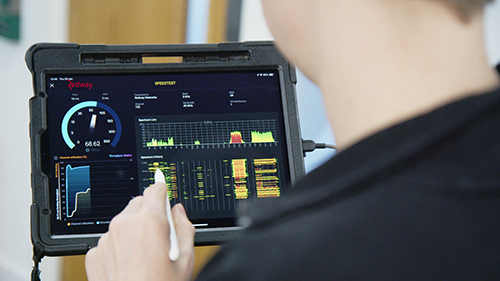
Channel planning is another common challenge. Without careful design, neighbouring access points may operate on overlapping channels, leading to co-channel interference and reduced throughput. A considered approach will prioritise the use of the 5 GHz band, and increasingly 6 GHz where available, while limiting reliance on 2.4 GHz to reduce contention.
Physical installation also plays a significant role in performance. Access points placed above ceiling tiles, inside cupboards, or near obstructions can severely impact coverage and signal quality. Survey heatmaps often highlight these issues clearly, revealing uneven coverage patterns or unexpected dead zones that would otherwise go unnoticed.
Ultimately, a reliable wireless network is not achieved through hardware alone. It requires careful design, thorough validation, and ongoing optimisation. For school IT managers, investing time and effort into proper planning and surveying is not an optional extra. It is a fundamental step in delivering a network that can support modern educational demands.
Redway Networks’ certified engineers have surveyed, designed, and deployed wireless networks across a wide range of school environments. We understand the unique challenges involved and work closely with schools to deliver solutions that balance performance, reliability, and budget, helping to create Wi-Fi networks that are ready for the future.
More information: Click Here
Redway Networks Ltd: 01908 046 400
Sales inquiries: [email protected]
General inquiries: [email protected]





Recommended Comments
There are no comments to display.